Sociology Revision Gcse Games For Kids
54 Cards in this Set
Games and Quizzes Most of the games on this site have been written by or for Arnewood students. They include Fling the Teacher (FTT), Penalty Shootout (PS), Walk the Plank (WP), Match-Up Quz (MQ), Interactive Diagram (ID), Half a Minute (HM), Multiple Choice (MC), Grade or no Grade (GG), Hoopshoot (HS), Practice Paper (PP) and En Garde (EG). Class notes, revision resources and exam advice for A-level sociology - covering education, families, research methods, beliefs, crime, theories and more!

- Front
- Back
Games For Boys
Unwritten rules special to our particular culture | |
The beliefs held by someone or a social group that help to build a set of norms. | |
Looking at social issues through the eyes of one particular type of theorist | |
Define the two main perspectives on the Theoretical approach | Some (structuralists) look at the big picture and show how society makes us what we are. They concentrate on the way that the structure of society has an influence on our everyday lives. Others (interactionists) focus down on smaller groups and individuals – they concentrate on the way people behave within society, how they interact with others and how people live their daily lives which, in turn, makes society what it is. |
A general state of agreement between individuals or groups | |
General state of disagreement between opposing groups | |
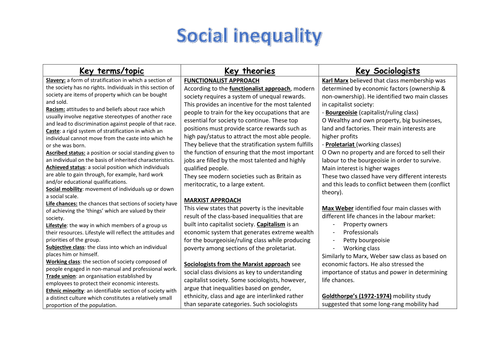
someone who sees the main divisions in society as being based on social class operating in a capitalist system | |
The way different groups in society are placed at different levels | |
The classification of people into groups that share the same culture, history and identity | |
term used to describe the informal process through which you learn the norms, attitudes, values and actions of your culture. Takes place in early childhood the main shaping influence is the family and home Family is one of the most important agencies of socialisation | |
The process of which people are persuaded to obey the rules and conform | |
doing what is expected and behaving in a way that is in agreement with norms. | |
The lifelong process of learning the skills, customs, attitudes, norms and values of your culture | |
Why may there be a difference in the quality and emphasis of primary socialisation? | Families in different social classes may approach this differently and put emphasis on different aspects. |
what students learn in their timetabled lessons i.e Maths and English | |
the ways of which the organisation of teaching, school regulations and routine shape pupils attitude and behaviour that is what students learn at school that is not taught in lessons. i.e punctuality, learning from your friendship groups | |
The groups and institutions that make up society such as families, the education system and the social stratification system. | |
Processes such as socialization, social control and social change. - | |
Issues and problems that affect individuals, groups and communities in their daily lives such as fear of crime, inequality and poverty. | |
: A sample that has the same characteristics as the population but is a smaller version of it. | |
Each member of the population has an equal chance of being selected. | |
Researchers take every ‘nth’ item from the sampling frame, for example every 20th name from a school register. | |
: Researchers divide the population into strata according to characteristics such as age, gender and ethnicity. | |
: Through contact with one member of a population, the research is introduced to, or identifies others in the same population. | |
A cross-sectional survey takes a cross section of the population and questions them on relevant issues only once. | |
Advantages and disadvantages of cross sectional studies? | Advantages: Not as time consuming as a longitudinal survey. Can be a cheap way of gathering a lot of information. Disadvantages: Cross- sectional A cross-sectional survey takes a cross section of the population and questions them on relevant issues only once. A questionnaire asking students about their attitudes towards sex only once Not as time consuming as a longitudinal survey. Can be a cheap way of gathering a lot of information. This only gives us a snapshot view. It only tells us about people at one particular point in time. |
Longitudinal A study of the same group over time. A questionnaire is given to a group of students concerning their attitudes towards sex. Disadvantages: A questionnaire is given to them every year until they finish University. Allows us to examine social change over time. Can be time consuming and expensive. | |
Agreed reward for positive actions or penalty for negative actions | |
Agencies of informal are Media families school All exert pressure to make sure you stick to the laws rules and norms of society | |
Main agencies are The police who make sure we conform to the laws created by legislature and investigate cases of law breaking The judiciary who deal with those who break law The prison who look after those who have been breaking laws Education as well as they have formal rules and impose negative sanctions if someone breaks law | |
The government taking responsibility for the health and financial wellbeing of population | |
Which group does the government use to define which class your in and how many categories are within that? | Registrars general classification 6 categories within |
Interviewer can explain with that questions mean All the respondents answer the same questions so results are easy to convert to quantitative data Reliable and easily repeated They can generalise the results to a representative sample | |
Preset questions means you cant look further into an answer and ask why if it is not one of the questions. interviewers have fewer opportunities to raise new issues The Interviewer Effect- respondents may be pressured to give socially acceptable answers to look like they fit in | |
Where someone cant afford to do things like activities that would be considered normal in society and not being able to posses certain things that would be considered the norm in society | |
A group concerned about a single issue that applies pressure to bring about change | |
what have groups tried to do to bring about change to the government about poverty? | The Child Poverty Action Group (CPAG) is the leading charity campaigning for the abolition of child poverty in the UK and for a better deal for low-income families and children.The End Child Poverty Coalition shows that 3.8 million children – one in three – are currently living in poverty in the UK. On an international level such groups as Christian Aid, Action on Aid, Live Aid, and the Catholic Agency for Overseas Development (CAFOD) all keep the issue in the spotlight. |
When media coverage of an issue leads to exaggerated public concern | |
Blowing things out of proportion by over reporting in the media i.e islamophobia | |
data is reliable if it can be repeated and consistently comes up with the same results. | |
data is valid if it gives a true image of what is being studied | |
a study on a small scale before main research is done | |
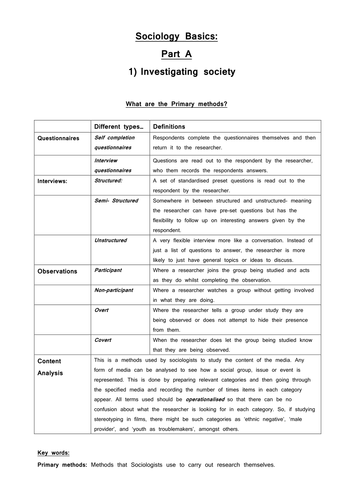
A limited number of possible answers are given and respondents have to choose from the options given to them. These are often presented as Yes/No or Agree/Disagree answers or can be a set of multiple-choice options. | |
quick, easy, collect a lot of data, easily converted into quantitative data, produce reliable data | |
questions can be biased, closed questions so respondents may not answer truthfully, questions may be misunderstood, lack of validity | |
someone who gives permission for others to be involved in your research. | |
: checking the accuracy of data collected through one method (for example, a questionnaire) by comparing it with data collected by using another method (for example, observation). | |
observations ( covert and overt), unstructured interviews, open questions in questionnaires, focus groups | |
As the researcher, you are actively involved in the group’s activities as well as making a record of what you see. A study of student behaviour in the classroom could be carried out in the lessons you attend; you would be participating as well as recording events. | |
You watch and record what is happening but are not involved in the group’s activities. If you were looking at the way teachers distribute their time between boys and girls in a primary school classroom, you might sit in a corner to observe and record from there. | |
journalists want to look for sensationalist stories, look for good stories by manipulating the truth to sell more copies of their magazine/ newspaper for money. sociologists look at why things are happening and the corrolation/patterns etc they look at the truth regardless of how boring or interesting it is. |