Download All Windows 7 Update After Sp1 Download
- Microsoft Windows 7 Update
- Windows 7 Updates Download
- Download All Windows 7 Update After Sp1 Download Free
- Oct 14, 2017. Over the years, Microsoft has released hundreds of updates for Windows 7, almost all of which are extremely important, which is why it is crucial for any user who installs Windows 7 Service Pack 1 from scratch on a computer to download and install each of these updates. Thankfully, Microsoft understands.
- Here I’m giving 2 ways to download Windows 7 updates for offline installation. Method 1: From SoftwarePatch. SoftwarePatch.com is a site that gives an accumulated list of all the updates to Windows 7 for free. The knowledge base number is given for your reference and then the patch name is given in the list.
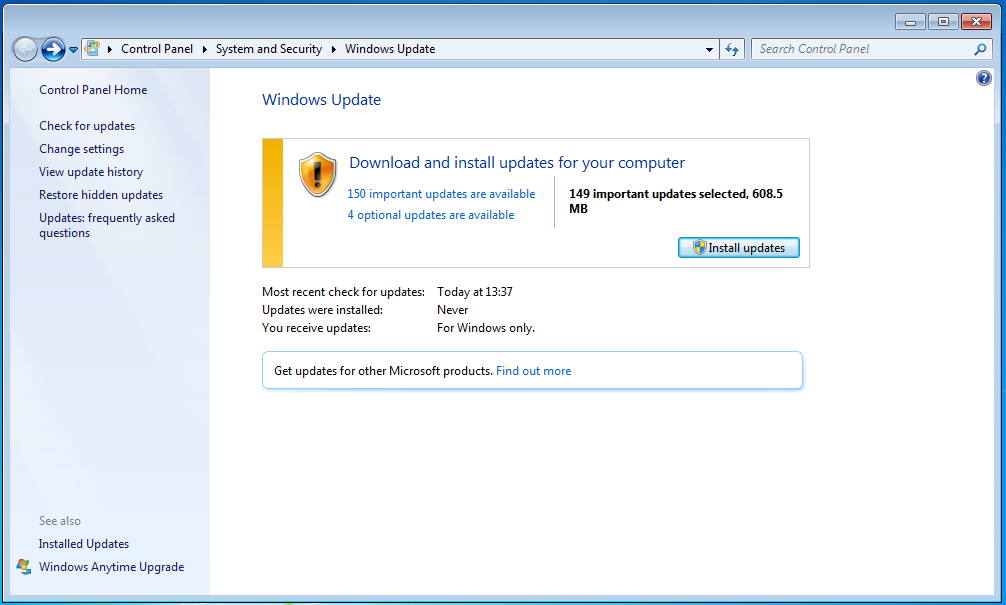
Windows 7 Updates seem to get stuck in a loop after a fresh install. With a few simple manual updates you can get things working correctly.
--UPDATE - I've been seeing a lot of reports from people about a new step to take. Before installing the updates in this how-to you may want to try disabling Windows Updates.
To download the latest updates, visit the Microsoft Windows Update website. ITunes for Windows requires Windows 7 or later, with the latest Service Pack installed. If you can't install the updates, refer to your computer's help system, contact your IT department, or visit support.microsoft.com for more help.
UPDATE 2 - it seems that this is getting more and more difficult. I would urge anyone reading this to read all the steps (and the conclusion) along with the pages of comments before giving up.
5 Steps total
Step 1: Make sure you have SP1 installed
Most people have media with SP1 already in it, but if yours is older it may not be included. If not, install it before anything else.
https://support.microsoft.com/en-us/help/15090/windows-7-install-service-pack-1-sp1
Step 2: Install IE11
Some of the MS pages don't work correctly with older versions of IE so getting IE11 installed first is a good idea.
https://support.microsoft.com/en-us/help/18520/download-internet-explorer-11-offline-installer
Step 3: Install KB3050265
This seems to be the key to everything. Windows Updates and many later manual updates will just spin for hours on end until this one is installed.
https://support.microsoft.com/en-us/kb/3050265
Step 4: Install the Windows 7 rollup
This is the closest to SP2 that we'll ever see for Windows 7. It includes most updates released after SP1 up until April 2016. It's much faster than downloading and installing all of them individually via Windows Updates.
https://support.microsoft.com/en-us/kb/3125574
NOTE: Read the Prerequisites section in the link. You will probably need to install 'April 2015 servicing stack update for Windows 7 and Windows Server 2008 R2 (KB3020369).' KB3020369 may not require a reboot. Reboot anyway!
Step 5: Install July 2016 update rollup
NOTE - adding this step 10/26/16 after reports that it helps move things along.
Install the July 2016 update rollup for Windows 7 SP1 and Windows Server 2008 R2 SP1:
https://support.microsoft.com/en-us/kb/3172605
After the above steps finish you should be able to install the rest of your needed updates normally, via Windows Updates. The first time you run it, though, it may still take several hours. Just be patient.
Alternatively, you can bypass Windows Updates completely with WSUSOffline - this will download the updates all at once, then install them (reboots and all) automatically. See link below.
References
- WSUS Offline Update
89 Comments
- MaceMike400 Aug 28, 2016 at 08:09pm
Installing SP1 and IE11 first also eliminates a whole lot of obstacles updates as well.
- Pure CapsaicinRod-IT Aug 28, 2016 at 09:58pm
You wouldn't believe how many times I re-iterate this to people
- PoblanoBryan7387 Aug 29, 2016 at 04:54pm
Agreed!! Server 2008 R2 is the same in that regard.
I haven't had as many issues with 2012 R2 it doesnt seem like, but went through a headache getting WSUS working for Win 8/10 and 2012 boxes right after their release. That might make for a good post as more people are likely to start moving to 2012 as 2008 is aging fast! I assumed that WSUS would work, but it took 2 out-of-WSUS-stream updates to get it happy.
- DatilCweb Aug 29, 2016 at 04:54pm
I would strongly recommend checking into an imaging solution that allows you to slipstream the updates into the image. I do this ever quarter with SCCM (haven't automated it yet). That makes a major difference in post install that things need to update.
- Pure CapsaicinDragonsRule Aug 29, 2016 at 04:56pm
Sure, creating an image with the updates already in it would be preferred. But sometimes that's not an option, like when you are wiping a home machine.
- ChipotlebozzoAIR Aug 29, 2016 at 04:58pm
I experienced this problem, and SP1 and IE11 did not do the trick for me. it drove me NUTS! I finally got the problem solved by manually installing kb3138612 and kb3145739
https://support.microsoft.com/en-us/kb/3138612
https://support.microsoft.com/en-us/kb/3145739Had to manually stop the Windows Update process and TrustedInstaller process to get ANY update to install, EVEN MANUALLY. As far as the roll up is concerned, i havent had the best experience with it so far. I've had a different issue with the roll up each time i tried to use it. I'm excited to see how things will work once the switch the windows 7 updates over to the Windows 10 style
- Pure CapsaicinDragonsRule Aug 29, 2016 at 05:00pm
bozzo - yes, steps 1 and 2 above are not enough. Step 3 (update KB3050265) is the key. The steps above, in the order listed above, worked for me this weekend and have been tested by several others here on SW.
- ChipotlebozzoAIR Aug 29, 2016 at 05:05pm
Larry - I COULD HAVE USED THIS ARTICLE TWO WEEKS AGO!! HAHAHAHA
Good stuff though. If you tried to look up solutions online, most peoples' solution was to disable windows update..hardly a solution. The specific problem that i was experiencing with the updates was the whenever i tried to update, svchost process started taking up 100% of the CPU. Disable the WindowsUpdate service gave the CPU all the resources back. Never the less, problem solved now! Great post - Serranotachikoma626 Aug 29, 2016 at 05:09pm
I've noticed this in a few new machines we've purchased, where I was building the image from scratch.
I just boot up, click to update and come back to it the next day. All 200+ updates are ready to install.
On a few existing machines that would not update, the convenience roll-up helped get them back up-to-date. - Poblanojeffbradford Aug 29, 2016 at 05:20pm
My last 10-20 builds do not even get that far. After a fresh install of Windows 7 pro 64bit, the first Windows update may take 24-48 hours or more. I had read some blogs online that Windows update site was having a bunch of issues when it was pushing out Windows 10 to users. But, now that the free upgrade is over, I had a PC that was built Thursday Aug. 25, and it is still trying to do it's first update.
- Serranosukhjitsingh105 Aug 29, 2016 at 05:28pm
Handy little guide, I'll use this as a base and send it out in an office email. Thanks mate, I've spent time a plenty reiterating this exact thing to many folks, tech and users alike.
- JalapenoRyan Kelly Aug 29, 2016 at 05:37pm
Thanks for posting this. I have been meaning to do this myself but have not gotten around to it. I have not had to install the roll-up and my fresh installs work most of the time but I am going to give it a shot with the roll up to see if it works all the time.
- TabascoITPro1000 Aug 29, 2016 at 05:38pm
Thanks for the post! I've been struggling with this and in many cases just wound up installing Windows 10 instead.
I assumed this issue was intentionally done by Microsoft to force people to install Windows 10 instead! - Thai PepperBDunbar5012 Aug 29, 2016 at 05:46pm
I had to do a fresh install at home about 2-3 months ago. It took a full week to get all the updates pulled down. It was a nightmare.
- Pure CapsaicinDragonsRule Aug 29, 2016 at 05:51pm
@Ryan Kelly - the rollup isn't needed, it's just a lot faster. It installs almost all updates from SP1 through April 2016 in one fell swoop. One download, one install.
- 1
- 2
- 3
- 4
- 5
- 6
Microsoft regularly releases major updates to their Windows operating systems.
Traditionally those updates are service packs, but more often these days, they're semi-regular and significant updates via Windows Update.
In fact, in Windows 10 and Windows 8, the service pack, as we know it from previous versions of Windows, is essentially a dead idea. Much like updates on your smartphone, Microsoft is continually adding major features via automatic patching.
Below you'll find all the latest information on both service packs and these other major updates that Microsoft is regularly pushing to its users.
Latest Major Updates to Windows 10
As of August 2019, the last major update to Windows 10 is Windows 10 Version 1903, referred to as the May 2019 Update and code-named 19H1. This update began rolling out on May 21, 2019.
Updating is completely automatic via Windows Update.
You can read more about the individual fixes and improvements on Microsoft's What's New in Windows 10 Version 1903.
Latest Major Updates to Windows 8
As of August 2019, the latest major update for Windows 8 is Windows 8.1 Update.1
Browse Doom 3 Weapon mod for Doom II files to download full releases, installer, sdk, patches, mods, demos, and media. Download doom 3 weapons mod doom 2 mods for win xp. You think what DoomEro is only one guy who rip out doom 3 weapons, You Are Wrong. AlphaEnt, developed this mod long ago and it is better wan doomero's rip sounds stripes even models (models and maintenance by Vavency). Blorc Doom II. Counter-Strike ZDoom Doom II. Doom X Doom II. Brutal Duke Nukem 3D Doom II. Doom Dynamic Doom II.
If you've already updated to Windows 8.1, the easiest way to update to Windows 8.1 Update is via Windows Update. See instructions for manually installing Windows 8.1 Update in the Download Windows 8.1 Update section of our Windows 8.1 Update Facts piece.
Microsoft Windows 7 Update
If you are not already running Windows 8.1, see How to Update to Windows 8.1 for detailed instructions on applying the Windows 8.1 update. When that's done, update to Windows 8.1 Update via Windows Update.
Microsoft is not planning another big update to Windows 8, like a Windows 8.2 or Windows 8.1 Update 2. New features, if available, will instead be pushed via updates on Patch Tuesday.
Latest Microsoft Windows Service Packs (Windows 7, Vista, XP)
The most recent Windows 7 service pack is SP1, but a Convenience Rollup for Windows 7 SP1 (basically an otherwise-named Windows 7 SP2) is also available which installs all patches between the release of SP1 (February 22, 2011) through April 12, 2016.
Windows 7 Updates Download
The latest service packs for other versions of Microsoft Windows include Windows Vista SP2, Windows XP SP3, and Windows 2000 SP4.
Download All Windows 7 Update After Sp1 Download Free
In the table below are links that take you directly to the latest Microsoft Windows service packs and major updates for each operating system. These updates are free.
Please note that for most of you, the easiest way to install the latest Windows service pack or update is to run Windows Update.
[1] Beginning in Windows 8, Microsoft began releasing regular, major updates to Windows 8. Service packs will not be released.
[2] Windows 7 SP1 and the April 2015 Servicing Stack Update both must be installed prior to installing the Convenience Rollup.
[3] Windows Vista SP2 can only be installed if you already have Windows Vista SP1 installed, which you can download here for 32-bit versions, and here for 64-bit ones.
[4] Windows XP SP3 can only be installed if you already have Windows XP SP1a or Windows XP SP2 installed. If you do not have one or the other of those service packs installed, install SP1, available here, before trying to install Windows XP SP3.
[5] Windows XP Professional is the only 64-bit version of Windows XP and the latest service pack released for the operating system is SP2.